As a Nutritionist you might not expect me to be focused on nasal health, but I find it fascinating! My interest started when I learned that zinc was pivotal to our sense of smell and it grew further when I learned about the microbiome environment of our sino-nasal area being as important as our gut bacteria. When I later learned that bitter and sweet signals in the sino-nasal environment affect how our immune system functions I was hooked!
Smell and taste are intimately connected, so consideration of the sino-nasal environment has become an intrinsic part of my work.
More than 7000 litres of air is breathed in every day by the average healthy human adult. With that air comes bacterial cells viruses and fungal organisms. The more exposure we have and the less well we are able to cope with that exposure the greater the risk of effects to our health.
Going beyond the bacteria themselves is also becoming increasingly important with laboratories now able to measure the level of biofilm for key species. When it comes to Chronic Inflammatory Response Syndrome (CIRS) the presence of biofilm relating to Multiply Antibiotic Resistant Coagulase Negative Staphylococcus (MARCoNS) is of critical importance.
Coag. Neg. Staph.is not an unusual bacteria to find in the sinuses. However, antibiotic resistance to 2 or more antibiotics is unusual. Studies indicate that in patients with low alpha melanocyte stimulating hormone (aMSH) 80% of nasal cultures were positive for MARCoNS. In those with normal aMSH levels the MARCoNS positive results were less than 1% (Shoemaker, 2004). Why might this be?
The most significant aspect of MARCoNS biofilm is the ability of the bacteria to produce exotoxins which break down alpha Melanocyte Stimulating Hormone (aMSH) locally in the sinuses. It is not uncommon to see low aMSH on CIRS biomarker testing, due to wider CIRS-related inflammatory effects on the pituitary.
aMSH and MARCoNS have a bidirectional relationship. Under normal conditions, aMSH protects the mucus membranes in the nose from colonisation. aMSH deficiency eliminates the protective barrier. As aMSH is produced in the pituitary gland in the brain we have to consider that pituitary function may have been compromised when levels are low, or that biofilm formation/MARCoNS/MARCoNS by-products have been excessively advantageous.
Nasal swab testing can be an important first-step in assessing the nasal biome. In the case of CIRS though what are we testing for?
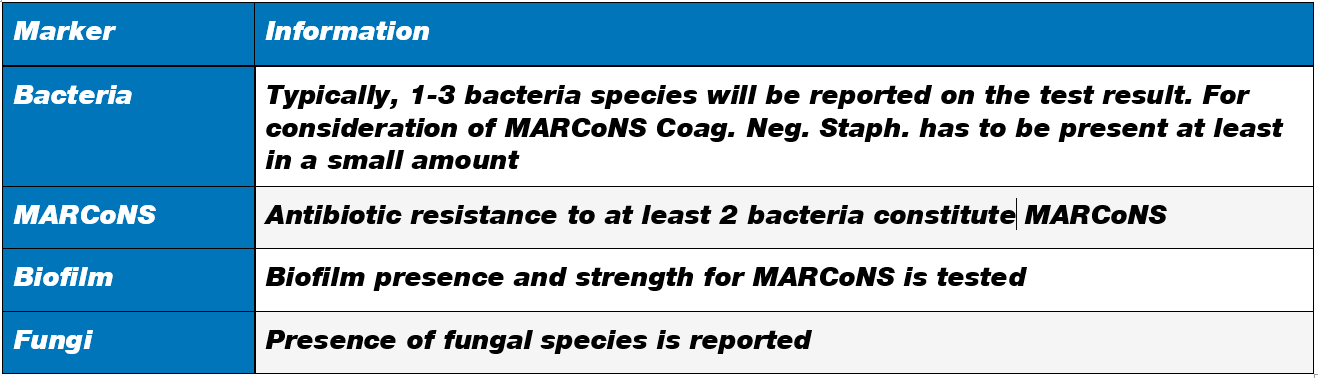
MARCoNS is found primarily colonising the human nasopharynx but can also be found in:
• Dogs noses (they can also become infected from our infections!)
• Dental Cavitations
• Foreign body replacements such as joints and valves
Testing can be particularly important for this with post-nasal drip or long-term sinus symptoms/surgical history. However, it can also be important if there is facial, forehead pain, sinus pain. Headaches can also be experienced, but some people are entirely asymptomatic. If aMSH levels are low then insomnia or sleep problems can be seen, along with an increased risk of pain, infections and membrane permeability.
The work of Dr Shoemaker showed that if MARCoNS is not eradicated then the therapeutic process can stall. This work was underscored when genomic testing began in 2011-12 and it was identified that suppression of mito-ribosomal function was associated with the presence of MARCoNS. We see this today on the GENIE test with down-regulation of both large and small mito-ribosomal units. Eradication of MARCoNS is therefore front and centre in the Shoemaker Protocol. It sits at step 3 of 12, coming after removal from exposure and initiation of binder therapy.
Eradication can take between 30 days and 6 months with the idea being to eradicate MARCoNS in conjunction with monitoring aMSH levels. If aMSH levels are not sufficiently robust then re-colonisation may be more likely to occur.
MARCoNS is of paramount importance as it shows that our own natural defences are compromised. The focus of that compromise is aMSH, but we must also remember that there are many immune factors in the sino-nasal environment that offer protection and that a healthy nasal microbiome is something we should all be striving for.
References:
Kumpitsch, C,Koskinen K, Schöpf V, Moissl-Eichunger C The microbiome of the upperrespiratory tract in health and disease BMC Biology 2019 17:87
Jousimies-Somer,HR, Savolainen S, Ylikoski JS Comparison of the nasal bacterial floras intwo groups of health subjects and in patients with acute maxillary sinusitis.J. Clin. Microbiol. 1989 Dec; 27 (12): 2736-2743
Shoemaker R.Surviving Mold: Life in the Era of Dangerous Buildings. Baltimore,MD: Otter BayBooks; 2010
Shoemaker RC.MARCoNS, biofilms and extracellular products. What are those bacteria making? (presentation, 4th Annual CIRSConference, Salisbury, Maryland, 2018 May 4-6)
Zhen Xu et al. Theprevalence, antibiotic resistance and mecA. characterisation of coagulasenegative staphylococci recovered from non-healthcare settings in London, UK.Anti biotic Resistance and Infection Control (2018) 7:73
Vandenesch, F,Lina G, Henry, Thomas “Staphylococcus aureus hemolysins, bi-componentleukocidins and cytolytic peptides: a redundant arsenal of membrane-damagingvirulence factors? Frontiers in Cellular and Infection Microbiology (2012)16 February

